
From Setback to Breakthrough: My Journey to Rediscover the Joy of Running
In the vast landscape of life, honesty often serves as our most reliable compass, guiding us through both triumphant peaks and challenging valleys. When I embarked on the journey of sharing my experiences through this blog, my core commitment was to paint an unvarnished picture of my life, embracing every twist and turn with genuine transparency. Today, I’m peeling back the layers to discuss one of those undeniable “downs” – a recent setback in my running aspirations that, while difficult to recount, ultimately led to profound insights and a renewed sense of purpose.
For those who have followed my previous posts concerning my running endeavors (you can catch up on my training journey here and here), you’ll know that I had been meticulously gearing up for a half marathon. This eagerly anticipated event was scheduled to take place just this past Saturday, a culmination of weeks of dedicated effort and unwavering commitment. However, life, as it often does, had other plans.
The Unspoken Truth: Acknowledging Failure
And so, with a deep breath and a heavy heart, I must admit a truth that has been incredibly challenging for me to articulate:
I FAILED.
Wow. Simply typing those words sends a ripple of discomfort through me. As a lifelong perfectionist, someone whose very identity is intertwined with dedication and follow-through, this admission feels like a stark contradiction to my core being. From my earliest days as a young girl venturing into the world of sports, an unshakeable work ethic has been my constant companion. When I commit to a goal, I pour every ounce of my energy into seeing it through to completion. Failure, in any form, has always been a bitter pill to swallow, and this recent experience has been no exception.
The Genesis of Aspiration: Our Training Journey Begins
Let’s rewind to the beginning of this particular journey. It was back in August when my husband, Bret, and I enthusiastically decided to embark on a shared mission: training for the Aspen Half Marathon. Our excitement was palpable, fueled by the prospect of conquering those beautiful mountain trails together. However, our initial enthusiasm was met with a minor bureaucratic hurdle when we discovered that registration for the Aspen race had filled up at an astonishing pace – much quicker than we had anticipated. You can read more about that particular hurdle here.
But true to our resilient spirit, we quickly pivoted. It wasn’t a major setback, merely a redirection. We promptly signed up for the Colorado Springs Half Marathon instead. This unexpected change actually brought with it a silver lining: an additional two weeks of training time! We saw it as a bonus, an opportunity to further refine our pace, build our endurance, and strengthen our bond as running partners. Score!
Unexpected Bumps in the Road: Losing My Running Buddy
Our training regimen progressed beautifully through the late summer. Up until the Labor Day holiday, our runs were consistently strong and invigorating. We were diligently working towards establishing a steady, consistent pace, and successfully adapting our bodies to early morning runs, embracing the crisp air and serene start to the day. The camaraderie between Bret and me was a powerful motivator, pushing us to achieve new distances and faster times.
Then, suddenly, Bret’s professional life took an unforeseen turn. His job responsibilities dramatically increased, thrusting him into a relentless cycle of travel. Since Labor Day, he has been on the road, almost constantly, like a veritable whirlwind. The demands of his work schedule became incompatible with the rigorous demands of half marathon training. With a great deal of sadness and understanding, Bret made the difficult decision to put his half marathon aspirations on hold. It simply wouldn’t be in the cards for him this time around.
My heart sank. The news hit me harder than I expected. I had just lost my dedicated running buddy, my unwavering source of motivation and shared experience. The thought of continuing on this journey alone felt daunting. What was I to do? After a moment of internal struggle, I rallied. I decided to do what any athlete, driven by an unyielding spirit, would do: I kept running. My logic was simple, albeit symbolic: I would run this half marathon for both of us, metaphorically carrying his aspirations alongside my own. Yet, despite my renewed enthusiasm and determination to press forward, destiny seemed to have yet another curveball in store.
The Painful Reality: An Athlete’s Setback
My focus and concentration, once unwavering, began to wane as an insidious pain started to manifest. During one of my longer training runs, my hip began to scream – not just a gentle ache, but a very loud, insistent protest. I knew, with an unsettling certainty, that something was profoundly wrong when I found myself unable to complete even nine miles, a distance I had previously managed with relative ease. This wasn’t merely discomfort; it was a debilitating pain that halted my progress and ignited a deep sense of worry.
Seeking answers, I turned to the highly esteemed Steadman Hawkins clinic here in Denver, a name synonymous with excellence in sports therapy and training – a veritable “messiah” for athletes in distress. I underwent an X-ray, holding onto a sliver of hope for a clear diagnosis and a straightforward path to recovery. To my immense surprise, the results indicated no broken bones, no muscle tears, and no excessive cartilage around the hip joint. Essentially, the medical verdict was that no surgery was required, and there appeared to be no major structural damage. While this should have been a relief, it primarily fueled my frustration and anger. How could “nothing be wrong” when I was clearly in such excruciating pain? It felt dismissive, as if my very real discomfort was being minimized. To simply call it a “strain” felt inadequate, almost insulting, given the intensity of what I was experiencing.
By mid-September, the persistent pain and lack of clear diagnosis forced my hand. I made the agonizing decision to completely cease my training. The internal battle was fierce; every fiber of my being wanted to push through, to conquer the discomfort. But the logical part of my mind knew that continuing to force the issue would only lead to further, potentially irreversible, injury. The shame I felt as an athlete for not being able to complete a race I had committed to was immense – a heavy burden to carry for someone who prides herself on finishing what she starts. This period was fraught with emotional turmoil, a collision of physical pain and psychological disappointment.
A Glimmer of Hope: Bret’s Engineering Logic and the Discovery of Chi Running
It was during this low point, when I was wrestling with my pride and frustration, that Bret, ever the pragmatic thinker, brought a new perspective to my attention. “Maybe it is your form?” he gently suggested. My immediate reaction was a mixture of incredulity and defensiveness. “What? Why would it be my form? Are you crazy? I am perfect! I’ve run a half marathon before; if I just rest my hip for a couple of months, I will be absolutely fine,” I retorted, fueled by stubbornness and a deeply ingrained belief in my own running prowess. Oh, how wrong I was.
This is precisely why I cherish my husband. Instead of engaging in an emotional debate or mirroring my stubborn resistance, Bret, with his characteristic engineering logic, quietly set about doing his research. He wasn’t just looking for a quick fix; he was seeking a fundamental understanding of efficient movement and injury prevention in running. His diligent investigation led him to a transformative discovery: a book titled “Chi Running,” penned by Danny Dreyer. Danny Dreyer is not just any runner; he is an ultra-marathoner, an individual capable of running distances of 100 miles or even more – a testament to his profound understanding of sustainable movement.
In “Chi Running,” Dreyer doesn’t merely offer a training program; he introduces a paradigm shift. He teaches runners of all levels how to run with greater efficiency, harmony, and in a remarkably natural way. The essence of his philosophy lies in working *with* your body, rather than forcing it, focusing on core engagement, body alignment, and a mindful approach to each stride. This method deviates significantly from the conventional wisdom that often emphasizes brute strength, pushing through discomfort, and merely powering through race courses. By adopting the principles of Chi Running, athletes learn to harness the body’s natural energy, minimize impact, reduce overall energy expenditure, and, most crucially, significantly decrease the risk of debilitating injuries. It was a revelation, suggesting that my pain wasn’t necessarily a sign of weakness, but perhaps a symptom of inefficient movement.
Unlearning Decades: The Challenge of Retraining My Body
For the longest time, I held a simplistic view of running. It was, in my mind, an intuitive act – something you just *do*. As a child, you’d “jet off to play” without a second thought about biomechanics. In school, you ran because your coach instructed you to, focusing on speed and endurance, rarely on the intricate mechanics of the movement itself. Consequently, the concept of running form, the subtle art and science behind efficient stride and body posture, simply never entered my consciousness. Until now. The realization that decades of unconscious movement might be contributing to my pain was both humbling and profoundly insightful.
For the past month, I have been diligently immersing myself in the practice of “Chi Running,” and I can unequivocally state that it is far from easy. Re-training your body, fundamentally altering a movement pattern that has been ingrained over 27 years, through countless steps and miles, is a monumental challenge. It requires an almost meditative focus, a constant internal dialogue with my muscles and alignment. Every run is a conscious effort to adjust, to align, to flow. There are moments of frustration, certainly, but also moments of breakthrough and quiet triumph. Slowly, but steadily, I am making progress. My hip, once a relentless harbinger of pain, now hurts less and less, a tangible sign that this new approach is yielding positive results.
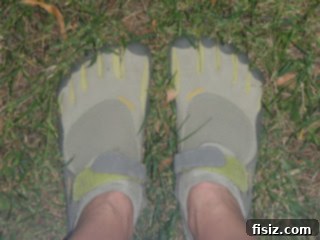
One of the most significant aids in this retraining process has been my decision to run in my Vibram FiveFingers shoes. These minimalist “barefoot” shoes offer immediate and unfiltered feedback on my foot strike and overall form. Unlike traditional running shoes, which often cushion and correct, Vibrams force me to engage with the ground in a much more direct way. They instantly highlight where I need to place my foot, encouraging a midfoot strike rather than a harsh heel strike, and critically, they compel me to keep my entire body, especially my hip, in proper alignment. This direct feedback loop is invaluable, acting as a constant, gentle coach for my form. Plug, much? Perhaps, but the results speak for themselves.
Reclaiming the Joy: A Path to Future Half Marathons and Beyond
I understand that for many, this journey – seeking alternative solutions when conventional medicine offers no clear answers to persistent pain – might sound unconventional, perhaps even a little “crazy.” But when doctors tell you nothing is structurally wrong, yet you continue to experience debilitating pain, you become driven to explore every possible avenue for relief and recovery. My unwavering plan is to continue diligently working on my running form, to ingrain the principles of Chi Running until they become second nature. This isn’t just about alleviating pain; it’s about fundamentally transforming my relationship with running.
My ultimate goal is not merely to participate in a half marathon next year, but to truly *enjoy* the experience once again, to cross that finish line feeling strong, efficient, and pain-free. I yearn to rediscover the pure, unadulterated joy of running – the freedom, the meditative rhythm, the profound connection with nature and my own body. This journey, fraught with initial failure and self-doubt, has ironically opened my eyes to a more sustainable, mindful, and ultimately more rewarding approach to my passion. It’s a testament to perseverance and the willingness to question long-held beliefs, even about something as seemingly simple as putting one foot in front of the other.
I am already planning a follow-up post in the near future that will provide a concise “cliff notes” version of the “Chi Running” book, for those of you who might be intrigued by its philosophy and wish to explore its concepts without diving into the full text immediately. Thank you for taking the time to read this rather lengthy, but deeply personal, account. Honestly, I’m incredibly relieved to have finally gotten all of this off my chest. Whew, what a release! I hope my experience resonates with anyone facing similar challenges in their fitness journey and inspires them to seek innovative solutions and never give up on their passions.