
Last night’s grocery run to Whole Foods was supposed to be a routine affair, a familiar dance through aisles to gather my weekly essentials. Typically, my shopping strategy involves a split approach: premium meats, fresh produce, and artisanal yogurts are sourced from Whole Foods, while everyday staples like milk and eggs are picked up more affordably at Safeway. This method allows me to balance quality with budget, ensuring I get the best value for specific items. However, the brewing storm outside had other plans, turning a simple errand into a hasty retreat. With the weather rapidly deteriorating and the wind howling, the thought of an additional stop at Safeway solely for eggs seemed more trouble than it was worth. This spontaneous decision led me to a rather significant deviation from my usual shopping list: a carton of cage-free organic eggs from Whole Foods. Little did I know, this seemingly minor purchase would kickstart a humorous domestic saga and prompt a deeper reflection on consumer choices in the bustling, often confusing, world of modern food marketing.
Decoding Egg Labels: Are Cage-Free Eggs Truly Better?
My partner, Bret, and I have often found ourselves deep in discussion, poring over countless research papers and articles dissecting the intricate world of egg production. The central question that consistently arises is whether “cage-free” eggs genuinely offer a superior advantage over their conventional counterparts, be it in terms of nutritional value, ethical considerations, or overall quality. This topic is a minefield of conflicting information, a veritable labyrinth where scientific studies often clash with powerful marketing narratives. Recent studies, including those commissioned by the USDA, have frequently concluded that there’s no significant nutritional difference between cage-free and conventionally farmed eggs. The protein content, vitamin profile, and mineral composition tend to be remarkably similar across the board. Yet, this scientific consensus often feels overshadowed by the pervasive “health halo” effect surrounding terms like “organic,” “cage-free,” and “free-range.” It’s a classic example of how clever branding can create perceived value, transforming a straightforward food item into a complex ethical and nutritional dilemma for the average consumer.
Navigating the Marketing Maze: Understanding Egg Terminology
The modern egg aisle is a testament to the power of marketing. Consumers are faced with a dizzying array of choices, each with its own promise and price point. Understanding what these various labels truly mean is crucial for making informed decisions that align with one’s personal values, whether those are animal welfare, nutritional benefits, or simply budget consciousness.
- Cage-Free Eggs: This term indicates that hens are not kept in cages. They have the ability to roam vertically and horizontally within indoor facilities, often with access to perches and nest boxes. However, it does not guarantee outdoor access, and the living density can still be quite high.
- Free-Range Eggs: Hens laying “free-range” eggs are provided with access to the outdoors. The catch here is that the amount and quality of this outdoor access can vary significantly, ranging from a small concrete patio attached to a barn to a vast, open pasture. There are no standardized minimum requirements for outdoor space.
- Pasture-Raised Eggs: This is generally considered the highest standard for hen welfare, implying that hens spend most of their lives outdoors, foraging on open pastures. Their diet includes natural elements like grasses, seeds, and insects, which many believe can lead to eggs with potentially higher levels of certain nutrients, such as Omega-3 fatty acids and Vitamin D, though consistent scientific proof remains a subject of ongoing research and depends heavily on the specific farm’s practices.
- Organic Eggs: These eggs come from hens fed organic, non-GMO feed, raised without synthetic pesticides or fertilizers, and typically also cage-free or free-range, adhering to strict organic farming standards. The organic certification addresses both the feed and the living conditions, aiming for a more holistic approach to animal welfare and product purity.
- Vegetarian-Fed: This label simply means the hens’ diet does not include animal by-products. While this sounds appealing, chickens are naturally omnivores, and an exclusively vegetarian diet may not be optimal for their health if not carefully managed.
- No Hormones Added: This label is largely meaningless for eggs, as federal regulations already prohibit the use of hormones in poultry production. It’s often used as a marketing tactic to imply superior quality where no such distinction exists.
The reality is that many of these labels, while offering improvements in animal welfare over conventional battery cage systems, don’t necessarily translate into dramatically different nutritional profiles for the eggs themselves. The primary benefits often lie in the ethical treatment of the animals and, for some, the perceived purity of the product. Understanding these nuances is key to making choices that align with one’s personal values and budget, rather than simply succumbing to the most appealing marketing slogan. For those interested in delving deeper into the actual differences and the science behind them, resources like this TIME magazine article offer valuable insights into the ongoing debate: http://www.time.com/time/health/article/0,8599,2002334,00.html.
The Price of Principle: Cost vs. Conscience in Egg Choices
Beyond the nutritional debate and the ethical considerations, there’s the undeniable financial aspect. Cage-free, organic, and especially pasture-raised eggs invariably come with a higher price tag. This premium reflects the increased costs associated with different farming practices – more space per hen, specialized organic or non-GMO feed, greater labor requirements, and the overhead of adhering to various certifications. This cost difference is precisely why I typically relegate my egg purchases to Safeway, where conventional eggs offer a budget-friendly option without, arguably, a significant compromise in fundamental nutrition for daily use. My impromptu Whole Foods purchase, driven by convenience over cost-effectiveness, was an anomaly, one I knew Bret, with his pragmatic approach to grocery budgeting and his healthy skepticism regarding unsubstantiated marketing claims, might not entirely appreciate. It’s a common dilemma for many shoppers: balancing the desire to support ethical farming practices or perceived health benefits with the realities of a household budget. Every shopping cart becomes a silent negotiation between ideals and practicalities, forcing consumers to prioritize what truly matters to them.
The Great Egg Disguise: A Humorous Domestic Endeavor
Knowing Bret’s discerning eye and his penchant for scrutinizing labels, especially when it comes to groceries that stray from our usual economic equilibrium, a mischievous idea began to form. As I unpacked the groceries, a cunning plan hatched to circumvent any potential “lecture” on the merits (or lack thereof) of premium eggs. My solution? A subtle, yet brilliant, act of deception. I carefully peeled off the prominent “Cage-Free Organic” label from the egg carton, attempting to transform it, by sheer will and sticker removal, into an anonymous container of “regular” eggs. The hope was that in the absence of a clear identifier, these pricier eggs would seamlessly blend into our refrigerator’s landscape, passing unnoticed and uncommented upon. The stealth operation was complete, or so I thought, as I placed the now incognito carton back into its familiar spot, a quiet triumph echoing in my mind.
| The attempt to hide the evidence: a carefully peeled egg carton, hoping to escape scrutiny. |
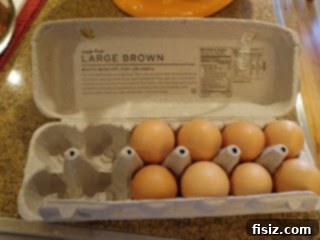
My confidence in this clever ruse was, regrettably, short-lived. What I failed to account for was Bret’s meticulous nature – the very quality that makes him an excellent engineer. An engineer, by profession, is trained to observe, analyze, and uncover the truth, no matter how subtly it’s concealed. Their minds are wired to seek out patterns, anomalies, and the underlying facts. And so it was with the eggs. Little did I consider that while the exterior label might be gone, the true identity of the eggs was often printed directly on the inside flap of the carton, a crucial detail for traceability, quality control, and branding that manufacturers rarely overlook. This internal labeling often contains vital information beyond just the type of egg, including farm codes, best-by dates, and processing details. It was a blind spot in my otherwise brilliant scheme.
Sure enough, during his next foray into the refrigerator, perhaps in search of an ingredient for his breakfast omelet, Bret’s keen eyes landed on the innocent-looking carton. A slight lift of the lid, a quick glance at the internal inscription, and the game was up. Emblazoned clearly on the inside was the irrefutable truth: “Cage Free Large Brown Eggs.” My elaborate disguise, meticulously executed with the cunning of a secret agent, had been thwarted by a simple, often overlooked detail. The look on his face, when he presented the evidence, was a mixture of amusement, a knowing “I told you so,” and perhaps a hint of admiration for the sheer audacity of the attempt. The truth, as they say, always finds a way out, especially when an engineer is involved.
Beyond the Carton: Making Informed Food Choices
This little incident, while humorous, serves as a powerful reminder of the broader challenges consumers face in today’s complex food landscape. It underscores the importance of looking beyond superficial labels and understanding the deeper implications of our choices. Whether it’s eggs, fresh produce, or highly processed packaged goods, the marketplace is saturated with claims that can be misleading, confusing, or simply not as impactful as they seem. The sheer volume of information, often contradictory, can lead to consumer fatigue, making it easier to simply grab the most appealing package without a second thought.
Making truly informed decisions about what we eat requires a blend of critical thinking, diligent research, and an honest understanding of our own priorities. Are we primarily concerned with animal welfare, seeking out certifications like Certified Humane or Animal Welfare Approved? Is nutritional density our main goal, leading us to consider pasture-raised options or specific feeding regimens that might influence Omega-3 content? Or is it simply about getting enough high-quality protein on a budget, making conventional eggs a perfectly viable and nutritious choice? There’s no one-size-fits-all answer, and what constitutes “best” is deeply personal.
Ultimately, the “best” egg, or any food product for that matter, is subjective. It depends on individual values, dietary needs, and financial constraints. What remains universal, however, is the need for transparency and education. As consumers, we have the power to demand more clarity from food producers and to arm ourselves with the knowledge necessary to navigate the complexities of food labels and marketing hype. My failed egg disguise, while a source of ongoing laughter in our household, ignited a fresh perspective on the subtle ways we are influenced by marketing and the often-hidden truths behind our everyday purchases. It reinforced the idea that being an educated consumer is an ongoing process, a continuous peeling back of layers to get to the core facts. So, the next time you’re in the grocery aisle, remember to look beyond the flashy front labels, scrutinize the fine print, and perhaps, just perhaps, peek inside the carton. You never know what secrets might be hiding within, waiting to be discovered by a keen eye, or a curious engineer.