
Unveiling Your Content’s Core: A Deep Dive into Word Clouds with Wordle
The Monday after a weekend of indulgence often brings with it a unique kind of fatigue – a “food hangover” that weighs heavily on both body and mind. Whether it’s the aftermath of a Super Bowl feast laden with nacho cheese, savory little smokies, rich cinnamon rolls, hearty chili, or sweet puppy chow, the feeling is universally understood. That familiar internal dialogue begins: “Self, exercise restraint. Avoid the second helping of spicy chili, perhaps limit the little smokies, and whatever you do, resist the temptation of a generous bowl of puppy chow.” Yet, despite these well-intentioned pep talks, we often find ourselves wrestling with the consequences, perhaps doing a few extra lunges just to get our work attire to fit comfortably the next morning. It’s a testament to the power of delicious food and good company, but it also leaves us craving something lighter, something that sparks intellectual curiosity rather than digestive distress.
In this spirit of seeking lighter, more insightful content, I recently stumbled upon a fascinating website that offers a unique perspective on our digital footprint. While catching up on my blog reading this past weekend, a tool emerged that I believe holds immense value for anyone involved in content creation, blogging, or simply understanding the underlying themes of written work. This website is called Wordle, and it’s far more than just a novelty – it’s a powerful visual analysis tool.
What is Wordle? The Art and Science of Word Clouds
At its core, Wordle is an online application that generates “word clouds” from text you provide. Imagine taking a substantial piece of writing – be it a blog post, an entire website’s content, a research paper, or even a collection of emails – and transforming it into a dynamic visual representation. This is precisely what Wordle, and similar word cloud generators, accomplish. The process is elegantly simple yet remarkably insightful: you input your chosen text (or a URL for a website), and the tool analyzes the frequency of words within that content. The more often a word appears, the larger and more prominently it is displayed in the generated cloud. Common, less meaningful words, often referred to as “stop words” (like “the,” “a,” “is,” “and”), are typically filtered out to ensure the cloud highlights the most significant terms.
The result is a visually engaging and immediately comprehensible snapshot of your content’s linguistic landscape. It transforms raw data into an artistic display, allowing you to grasp the core themes and predominant vocabulary at a glance. This capability is incredibly powerful, offering a novel way to interpret and analyze written communication.
Why Word Clouds are Indispensable for Content Creators and Beyond
The utility of a word cloud extends far beyond mere aesthetic appeal. For bloggers, marketers, educators, and anyone who produces or consumes large amounts of text, word clouds offer a wealth of actionable insights:
1. Elevating Your SEO & Keyword Strategy
One of the most compelling applications for content creators is in optimizing search engine performance. By feeding your blog or website’s URL into Wordle, you can instantly see which keywords are naturally surfacing in your content. Are the words you *want* to rank for appearing prominently? Or are there unexpected terms dominating the visual landscape? This offers a quick and dirty audit of your current SEO efforts, highlighting whether your content truly reflects your target keywords. If a crucial keyword for your niche is surprisingly small in your word cloud, it’s a clear indicator that you might need to adjust your content strategy to incorporate it more effectively and naturally. This visual feedback makes it easier to refine your content for better visibility and organic traffic.
2. Gaining Clarity on Your Content’s Core Themes
Sometimes, as writers, we can get lost in the weeds of our own words. A word cloud provides an objective, bird’s-eye view of your content’s central message. It answers the fundamental question: “What is my content truly about?” This is invaluable for ensuring consistency in your messaging and confirming that your output aligns with your overarching content goals. It helps you identify whether your blog is perceived as being about “technology” when you intended it to be about “digital marketing,” for instance. This clarity is vital for maintaining a strong brand voice and focusing your efforts effectively.
3. Identifying Unintentional Repetition and Enhancing Vocabulary
We all have our go-to phrases and verbal tics. Word clouds can mercilessly expose these habitual word choices. If words like “really,” “just,” “actually,” or other common filler words appear disproportionately large, it’s a gentle nudge to diversify your vocabulary and make your writing more concise and impactful. This doesn’t mean eliminating these words entirely, but rather becoming more conscious of their usage and exploring synonyms to enrich your prose. As a writer, expanding your lexicon is an ongoing journey, and a word cloud can be a surprisingly effective guide for self-improvement and stylistic refinement, leading to more engaging and professional writing.
4. Understanding Audience Perception and Engagement
While Wordle analyzes your output, it implicitly provides insight into how your audience might perceive your content. If the most prominent words are overly technical and you’re aiming for a general audience, it might indicate a need to simplify your language. Conversely, if you’re targeting experts, a lack of specialized terminology could suggest your content isn’t diving deep enough. Analyzing comments sections or customer feedback through a word cloud can also reveal the dominant sentiments and topics that resonate most with your readership, helping you tailor future content to their interests. This feedback loop is crucial for fostering engagement and building a loyal audience.
5. Versatile Applications Beyond Blogging
- Education: Teachers can use word clouds to quickly summarize complex texts, helping students grasp key concepts. Analyzing student essays with a word cloud can highlight common themes, strengths, and areas for vocabulary improvement, making feedback more visual and engaging.
- Marketing & Sales: Marketers can analyze customer reviews, social media discussions, or competitor websites to identify prevailing trends, brand perceptions, and keywords resonating with their target demographic. Sales teams might use it to understand common objections or interests from client communications, informing their strategies.
- Personal Insight: Even for personal journaling, a word cloud can reveal subconscious themes, recurring thoughts, or dominant emotions over a period, offering a unique and visually compelling form of self-reflection and personal growth.
- Data Visualization: For researchers and analysts, word clouds offer a compelling and accessible way to present qualitative data, making complex information digestible for a broader audience without losing the essence of the data.
- Brainstorming & Idea Generation: By inputting a topic and associated words, a word cloud can help visualize related concepts, sparking new ideas and connections for content creation or problem-solving.
My Own Word Cloud Revelation: A Moment of Enlightenment (and a Bit of Irritation!)
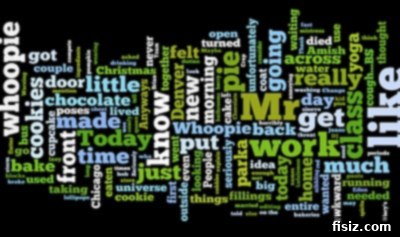
Naturally, after discovering Wordle, my first inclination was to feed my own blog’s URL into the generator. The results were, to say the least, illuminating. The visual representation of my most frequently used words offered a candid mirror to my writing style and thematic focus. What I saw made me pause, offering a blend of affirmation and a gentle challenge for future content creation.
The words that stood out most prominently were “like,” “cookies,” “know,” “work,” “class,” and “Mr.” Initially, I wasn’t sure whether to feel enlightened by this clear snapshot of my blogging habits or slightly irritated by the apparent need to consciously expand my vocabulary. “Like” is a common conversational filler, which makes sense in my informal blogging style, but its prominence suggested an opportunity for more varied phrasing. “Cookies” immediately brought to mind the numerous recipes and baking adventures I’ve shared, indicating a strong culinary theme that clearly resonates through my content. “Know” likely reflects my frequent attempts to impart knowledge or express understanding in my posts, pointing to a helpful, informative tone. “Work” and “class” probably stem from discussions about daily routines, professional experiences, or learning endeavors, which are recurring topics on my blog, suggesting a focus on personal and professional development. And “Mr.”? That was a charming surprise, undoubtedly linked to anecdotes involving specific individuals or perhaps fictional characters I’d referenced, adding a personal, narrative touch.
This self-analysis was incredibly valuable. It highlighted the topics I naturally gravitate towards and the casual tone I often adopt. While these aren’t necessarily negative, seeing them so starkly presented encouraged me to reflect on my writing. Am I diverse enough in my topics? Could I articulate certain points with richer vocabulary? It’s not about censoring my natural voice, but about refining and enhancing it for greater impact and broader appeal. This exercise prompted me to consider how I can maintain my authentic voice while also consciously pushing the boundaries of my linguistic choices to offer a more nuanced and engaging experience for my readers.
Your Turn: Discover Your Content’s Unique Signature!
I wholeheartedly encourage you to give Wordle a try. It’s a free, simple, and profoundly insightful tool that can offer a fresh perspective on your own writing, be it your personal blog, professional website, or even a collection of thoughts. Head over to Wordle.net, paste in some text or a URL, and watch your words come to life in a vibrant cloud. You might be surprised by what you discover about your own writing patterns and thematic focus.
Once you’ve generated your own word cloud, take a moment to reflect on what it tells you. What are your most dominant words? Do they align with your intentions for your content? Are there any surprises that challenge your perceptions? I’d love to hear about your top five most frequent words and what revelations they bring. Share your insights in the comments below – let’s compare notes and discover the hidden linguistic patterns in our digital expressions, fostering a community of writers dedicated to understanding and improving their craft!