
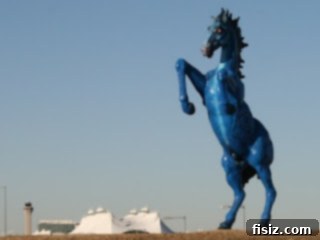
The Enduring Mystery and Controversy of Denver International Airport’s Blue Mustang
As another adventure begins with the Tour de Kansas, it’s incredible to reflect on the relentless pace of life and travel. Just days ago, we navigated the bustling corridors of Denver International Airport (DIA), and here we are, embarking on a new journey. The sheer energy and logistical prowess required for such continuous movement always leave me wondering about the remarkable resilience of individuals like Mr. B.
Every trip to or from Denver International Airport offers a distinctive landmark that inevitably sparks conversation: the colossal blue mustang sculpture gracing its entrance. This striking, some might say jarring, piece of public art has become an undeniable fixture of the DIA experience, inviting contemplation, confusion, and sometimes, outright disdain from travelers and locals alike.
Unpacking the Symbolism: Freedom, the West, and Fierce Debates
A few years ago, the City of Denver commissioned this monumental sculpture, officially named “Mesteno” (Spanish for “Mustang”), with the stated intention of representing the untamed spirit of freedom and the enduring strength of the American West. While admirable in its aspiration, the realization of this artistic vision has proven profoundly divisive. One cannot help but ponder: does a gargantuan blue mustang, rendered with such pronounced anatomical detail, truly evoke the noble ideals of freedom and pioneering spirit for every observer? For many, including ourselves, its imposing presence and somewhat unconventional aesthetics spark more questions than profound patriotic sentiments.
Public art, by its very nature, is designed to engage, provoke, and sometimes challenge the viewer. The Blue Mustang at DIA certainly achieves this, perhaps to a degree unforeseen by its commissioners. Its bright, almost electric blue hue, combined with its sinewy form and piercing red eyes, creates a dramatic spectacle that is difficult to ignore. While some praise its bold contemporary style and the way it commands attention in a vast, open landscape, others find it jarring, even unsettling, a “monstrosity” that clashes with the natural beauty of the Rocky Mountains it stands before. This stark divergence in perception underscores the complex relationship between artistic intent and public interpretation.
The Tragic Genesis: Luis Jimenez’s Legacy
Beyond its striking appearance and the debates it engenders, the Blue Mustang carries a poignant and tragic history. The sculptor, the brilliant and often controversial artist Luis Jimenez, met a sudden and untimely demise while bringing his vision to life in his New Mexico studio. It wasn’t until recently that I learned the full, heartbreaking details: Jimenez was assembling the final, intricate sections of the sculpture when a large piece, specifically the torso, unexpectedly broke free. It tragically crushed him, leading to his death in 2006, just before the project’s completion. This grim twist of fate adds a layer of somber irony to an already contentious artwork, forever intertwining its story with the ultimate sacrifice of its creator.
Jimenez was renowned for his large-scale, fiberglass sculptures that often explored themes of the American West, immigration, and working-class life. His distinctive style, characterized by vibrant colors and dynamic forms, was meant to be accessible and impactful. The Blue Mustang, in many ways, is a quintessential Jimenez piece, embodying his commitment to monumental art that speaks to collective experience. The tragedy of his death transformed the sculpture from merely a piece of public art into a powerful, albeit dark, monument to the artist’s dedication and the inherent risks of such ambitious creative endeavors. It forces a moment of quiet reflection, tempering the more lighthearted criticisms with a somber recognition of the human cost involved in its creation.
The Price Tag and Public Outcry: A Question of Priorities
The cost associated with this massive artwork also fueled significant public debate. The city of Denver paid a staggering $656,000 for its acquisition and installation. In the realm of public spending, especially for art, such figures often draw scrutiny. Many taxpayers openly questioned whether this was a judicious allocation of funds, particularly when weighed against other pressing urban needs. The perception of value in art is inherently subjective, but when public money is involved, the discussion often shifts from aesthetic appreciation to fiscal responsibility. For a piece that some immediately labeled a “hideous beast,” the price tag only amplified the discontent, leading to calls for greater transparency and accountability in public art commissions. This debate around cost versus artistic merit is a common thread in public art projects globally, highlighting the perpetual tension between cultural enrichment and practical resource management.
The conversation wasn’t just about the financial outlay; it quickly escalated into a full-blown cultural phenomenon. The “mustang controversy” became a local legend, a subject of endless discussion in cafes, online forums, and community meetings. The sculpture inadvertently ignited a crucial dialogue about what constitutes “good” public art, who gets to decide, and how much a community is willing to invest in it. This widespread engagement, whether positive or negative, arguably makes the Blue Mustang one of the most talked-about and therefore, in a way, successful pieces of public art in recent memory.
“Bluecifer” and Beyond: Nicknames and the Evolution of a Landmark
Ever since its controversial unveiling, the Blue Mustang has garnered a growing legion of detractors in Denver and beyond. It seems we are certainly not alone in our somewhat bewildered appreciation – or lack thereof – for a giant blue equine sculpture with such pronounced anatomical features. The public’s reaction has been so intense and varied that several unofficial, often unflattering, nicknames have emerged, firmly embedding the sculpture into local folklore. Social media groups and local residents have playfully, and sometimes scathingly, dubbed it “Beelzebub’s Blue Bay,” “Satan’s Stallion,” and most famously, “Bluecifer,” a portmanteau referencing its blue color and perceived demonic intensity, especially given its glowing red eyes at night.
Mr. B and I, in our own private commentary, have affectionately, or perhaps ironically, named it “The Glowing Blue Donkey.” These nicknames, far from diminishing the sculpture’s presence, have cemented its status as a local icon, a touchstone for conversation, and a unique part of the Denver experience. They reflect a deeper societal tendency to reclaim and rename public symbols, injecting them with humor, cynicism, or affection, transforming them from mere objects into shared cultural narratives. “Bluecifer” isn’t just a sculpture; it’s a character in Denver’s evolving story, a testament to the power of art to captivate, infuriate, and inspire a collective imagination.
Its undeniable presence has made it an unofficial mascot for DIA, a point of reference that even first-time visitors quickly recognize. It’s often the first thing people see when arriving and the last thing they see when departing, ensuring its place in their memories, regardless of their personal feelings towards it. This pervasive visibility, combined with the ongoing discussion, solidifies its role not just as a piece of art, but as a genuine landmark, inextricably linked with the identity of Denver International Airport itself.
From Blue Mustangs to Holiday Delights: The Journey Home
In any case, enough of my musings on this striking, and often debated, blue equine masterpiece. The vivid discussions it provokes are a testament to its powerful impact, but now our focus shifts to more immediate and heartwarming matters. Mr. B and I are eagerly anticipating our journey home for the holidays, a time cherished for its warmth, comfort, and the simple joys of family. After the adrenaline of the Tour de Kansas and the constant motion of travel, the prospect of settling into the rhythm of the holiday season is a welcome one.
The coming weeks promise a delightful abundance of eating, a cherished tradition involving all our favorite festive dishes, and, most importantly, the chance to reconnect with beloved family members. These moments of shared laughter, storytelling, and creating new memories are the true anchors of our year, grounding us amidst our many adventures. There’s a unique comfort in returning to familiar surroundings, to the faces and places that define “home.”
As the festive season approaches, a hint of childhood wonder lingers. I find myself wondering with a playful curiosity: what delightful surprises might Santa have in store for me this year? The anticipation of gifts, however small, adds another layer of joy to an already exciting time, capping off a year of travel, experiences, and memorable encounters with fascinating public art.